See the task. Move with purpose.
We connect cameras, sensors, software, and mechanisms around one useful physical task—from inspection and handling to field automation.
Robotics & vision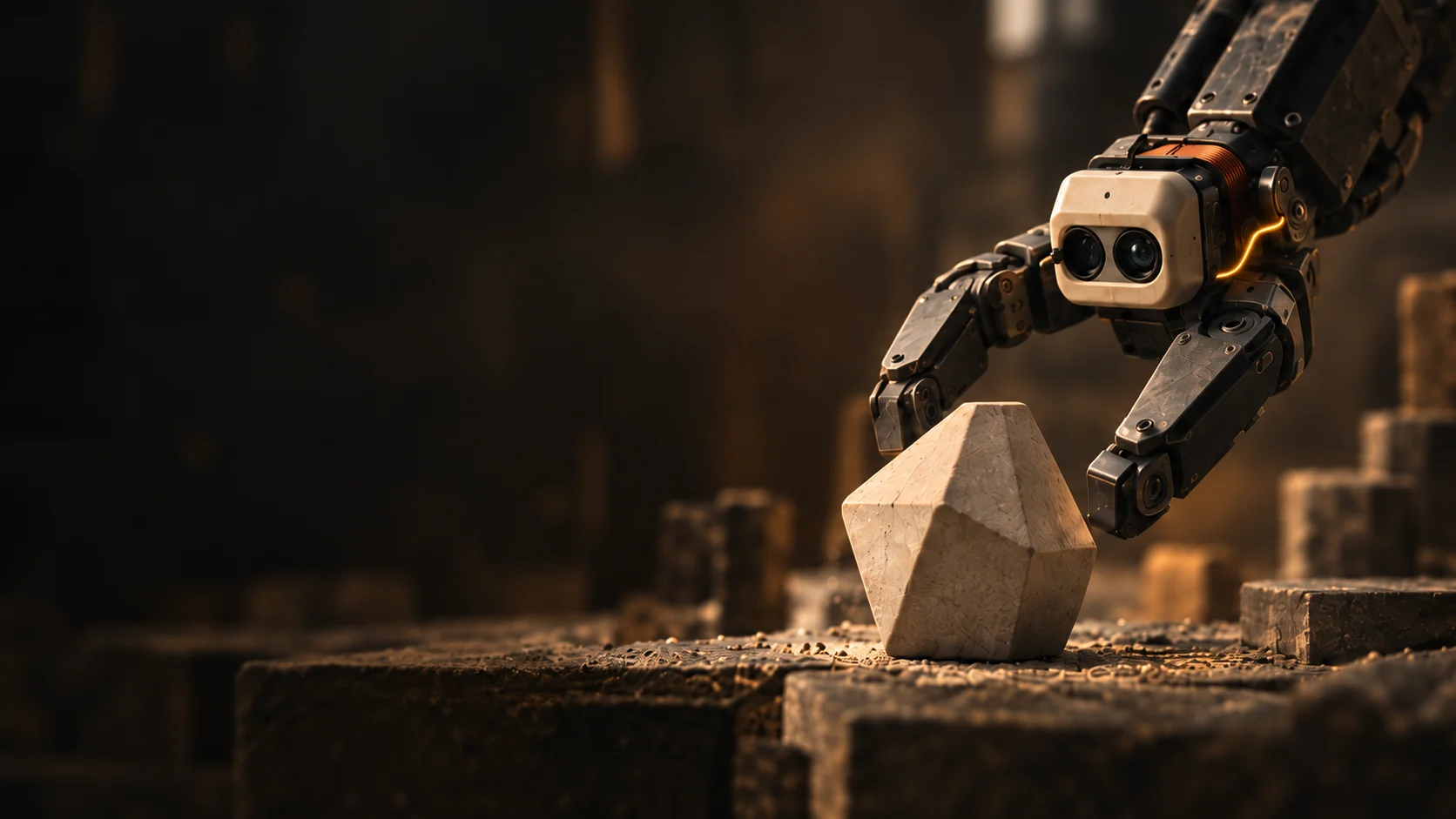
Drag or use arrow keys to rotate. Home resets the view. Space pauses or resumes motion. Illustrative geometry, not a validated hardware design.
Ribhu Labs builds robotics and computer-vision prototypes that connect sensing, control and feedback around one physical task, such as inspecting a part or guiding a pick. It starts with a one-week review of the task, the environment and what a first bench prototype should prove.
Make the move
legible.
A useful robot has to work with the objects and conditions in front of it. Lighting changes. Materials vary. A successful motion needs more than a command: it needs a way to sense the task, explain the decision, and confirm the result.
We map the end-to-end loop: observe, interpret, plan, move, and verify. Then we integrate the chosen hardware, test the conditions that affect performance, and keep failures visible to the operator. The evidence guides the next stage of engineering and deployment.
From sensing to action.
A physical system becomes easier to trust when every observation, action, and exception has a visible place.
The loop is the product: see what is there, choose a bounded action, then keep the result available for review.
Perceive
Determine what sensors can observe and where uncertainty remains.
Plan
Connect a validated observation to a constrained, reviewable action.
Move
Coordinate a deliberate motion with limits the operator can understand.
Verify
Use feedback to check what happened and route exceptions to an operator.
What we
can deliver.
Scope is agreed around your systems, constraints, and intended outcome.
- 01
A physical task brief with operating conditions, safety boundaries, and acceptance criteria
- 02
A computer-vision, sensing, or control prototype connected to a repeatable test setup
- 03
A traceable observation-to-action flow with operator review and exception handling
- 04
Test results, failure cases, and an engineering plan for the next stage
From question
to capability.
- 01
Define the physical task
Identify the objects, environment, required movement, and result the system needs to verify.
- 02
Build the sensing and control loop
Connect perception to a bounded action. Test components individually, then bring them together in a working prototype.
- 03
Measure and refine
Test variations in the real task, record failures, and identify what must change before production use.
A little more
clarity.
Is a prototype ready for production?+
A prototype establishes what works under tested conditions. Production use needs further engineering, hardware validation, safety assessment, and an operating and maintenance plan.
Can you use hardware we already own?+
We can assess the device, its interfaces, and its documentation, then determine how it fits the task and what additional components are needed.
Where does AI fit?+
AI can help recognise objects, interpret images, or support planning. The control loop still needs explicit limits, feedback, and a defined response when the system cannot complete a task.
Workflow Review
We map one process with the people who do it, and mark where a rule, a model, or nothing at all belongs.
You get: A process map, a shortlist of changes and a clear go or no-go. Yours to keep, whoever builds it.
4 weeksPilot Build
One working piece built on your own data or task: tested with your team, documented, and handed over with training.
You get: A working system for one process, its source and documentation, and a team that can run it.
Half a dayTeam Workshop
A hands-on session using your own examples: where AI fits, how to map an automation, how to check a result.
You get: A shared vocabulary and two or three candidate processes worth reviewing.